What the work is
Otl Aicher led the design team for the 1972 Munich Olympics. The programme connected sports pictograms, Univers typography, colour-coded functions, posters and the event emblem.
According to Wikipedia, the organisers asked Aicher in 1966 to be lead designer, with a brief to complement the newly built stadium designed by Günther Behnisch. He consulted Masaru Katsumie, who had designed the 1964 Tokyo Olympics. Aicher had co-founded the Ulm School of Design in 1953 and is described as a pioneer of corporate design, with work on the corporate identities of Braun and Lufthansa.
How it was made
Grid systems helped give the pictograms related proportions. The team also used a shared palette across signs, printed material and staff clothing, while posterised sports photographs connected photographic imagery with those colours.
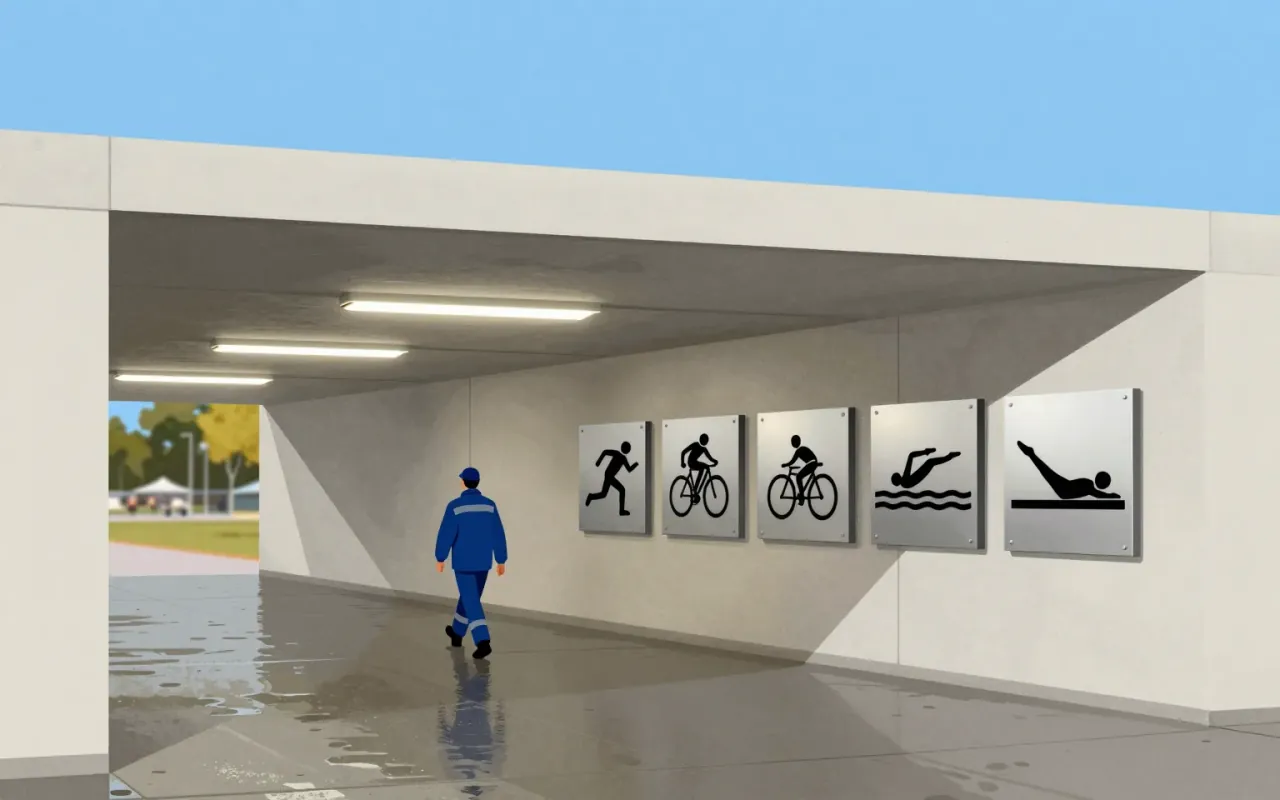
The pictograms were based in part on the iconography of the 1964 Games and were meant to give athletes and visitors a visual interpretation of each sport so they could find their way around the Olympic village and stadium. Each had to work as a clear sign of its activity while staying universally comprehensible. For the emblem, the team went through several stages. Early ideas drew on the city’s coat of arms, the Münchner Kindl, or on the sun, mountains and landscape around Munich. The result was the Strahlenkranz, a garland that stood for the sun and also merged the five Olympic rings into a spiral. Coordt von Mannstein reworked Aicher’s original design mathematically to join the garland and spiral.
The colours were chosen to reflect the tones of the Alps: blue and white, with green, orange and silver. Different colours marked themes such as media, technical services, celebrity hospitality and public functions, so visitors could tell them apart around the stadium and village, and uniforms were coordinated to match, so staff could be identified by department. The team used Univers for the Olympic designs and produced 21 sports posters carrying the logo and the words München 1972. For their graphics they used posterization, separating the tonal qualities of the images by hand and printing in the official colours. The first poster, of the Olympic stadium, became the official poster. These were hung in pairs alongside posters by artists the Games chose, including David Hockney, R. B. Kitaj, Tom Wesselmann and Allen Jones. Aicher also created the first official Olympic mascot, a striped dachshund named Waldi.
What works
The system made difference legible within a common framework. Individual sports and functions could have distinct signs while still belonging to one event identity, reducing the need to solve each application independently.
What does not
Pictograms aim to cross language barriers, but recognisable form is not proof of universal comprehension. The useful test is whether a viewer can distinguish the represented activities and find the relevant information in context.
What it influenced
The Munich pictogram approach influenced the United States Department of Transportation’s 1974 public-signage symbols. That is a specific connection between the event programme and a later system for everyday wayfinding.
The DOT pictograms applied the same principles to standard public signage such as toilets and telephones, and Wikipedia says they have in turn been used around the world.
Is it worth your time
Worth studying for complex information systems. Compare several pictograms with a poster and a staff uniform. The relationships between these applications reveal how rules can support variety without dissolving the identity.