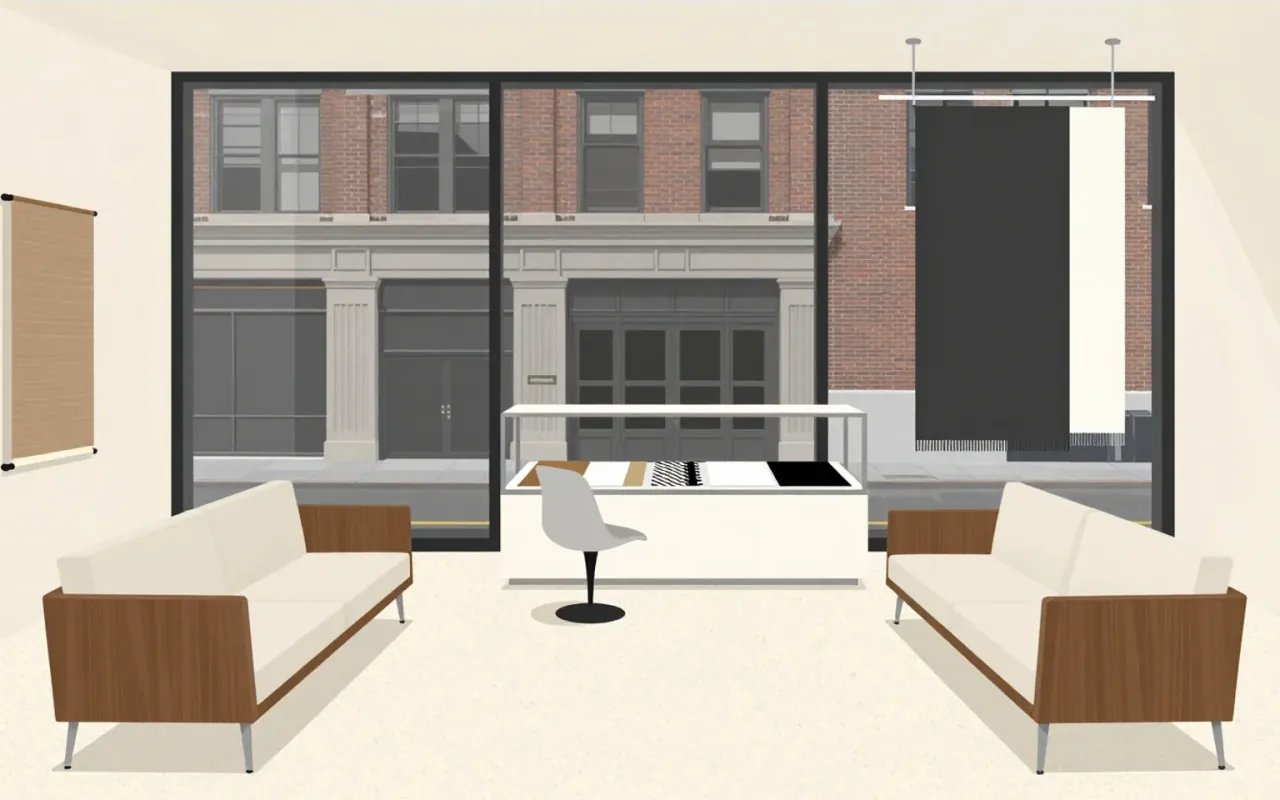
What the work is
The work is the Knoll Planning Unit: a service that delivered over 70 office interiors for major American companies between 1943 and 1965. It was a method, not a single object—a system for translating work patterns into spatial organisation, furniture selection, and textile integration.
How it was made
Florence Knoll created and directed the Knoll Planning Unit from 1943 to 1965. She conducted interviews to identify clients’ work needs. She co-built Knoll Associates with her husband Hans Knoll into a leader in furniture and interior design. She worked to professionalize interior design by fighting gendered stereotypes of the decorator.
What works
Its open, rationally organised office designs used modernist furniture and humanised geometries—textures, organic shapes, colour—to serve office workers’ needs. Its interview-based planning method treated space as functional infrastructure, not aesthetic surface.
What does not
The material does not establish any specific furniture piece, textile pattern, or building designed solely by Florence Knoll. It does not attribute authorship of individual objects, nor does it specify materials, dimensions, manufacturing methods, or budgets.
What it influenced
It influenced how corporations approached workplace design—shifting from ornamental arrangement to integrated, client-centred planning. It helped institutionalise interior design as a professional field distinct from decoration.
Is it worth your time
Yes. It redefined office interiors as rational, humanized systems—not backdrops—and established interior design as a discipline grounded in spatial analysis, not decoration.