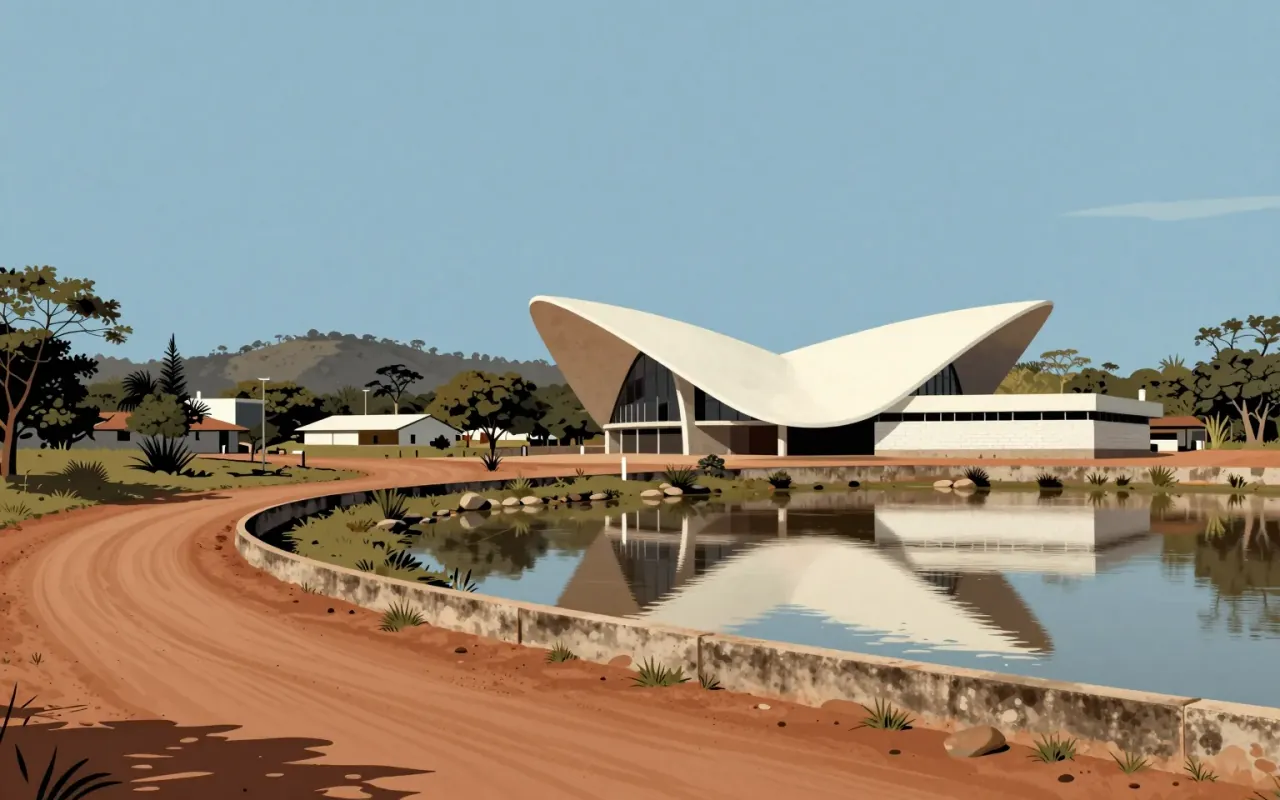
What the work is
A body of architectural work defined by curves, abstraction, and the unification of structural elements—most notably in the Church of Saint Francis of Assisi at Pampulha and Brasília’s civic buildings.
How it was made
He used reinforced concrete’s plasticity to reject right angles and rationalist orthodoxy. He unified wall and roof into a single structural element. His method was economical, exploiting concrete’s inherent malleability.
What works
The fusion of vertical and horizontal elements into one expressive surface works. The sensual, site-responsive curves work. The economy achieved through concrete’s plasticity works.
What does not
The work does not resolve functional programming. It abandons rationalist orthodoxy without offering an alternative logic for interior organisation or user flow.
What it influenced
It influenced late 20th- and early 21st-century architecture by demonstrating how reinforced concrete could generate a language of abstraction and curve—distinct from both modernist geometry and historicist ornament.
Is it worth your time
Yes—if you need to understand how material constraint can drive formal rebellion in architecture. No—if you seek functional rigour or programmatic clarity.