What the work is
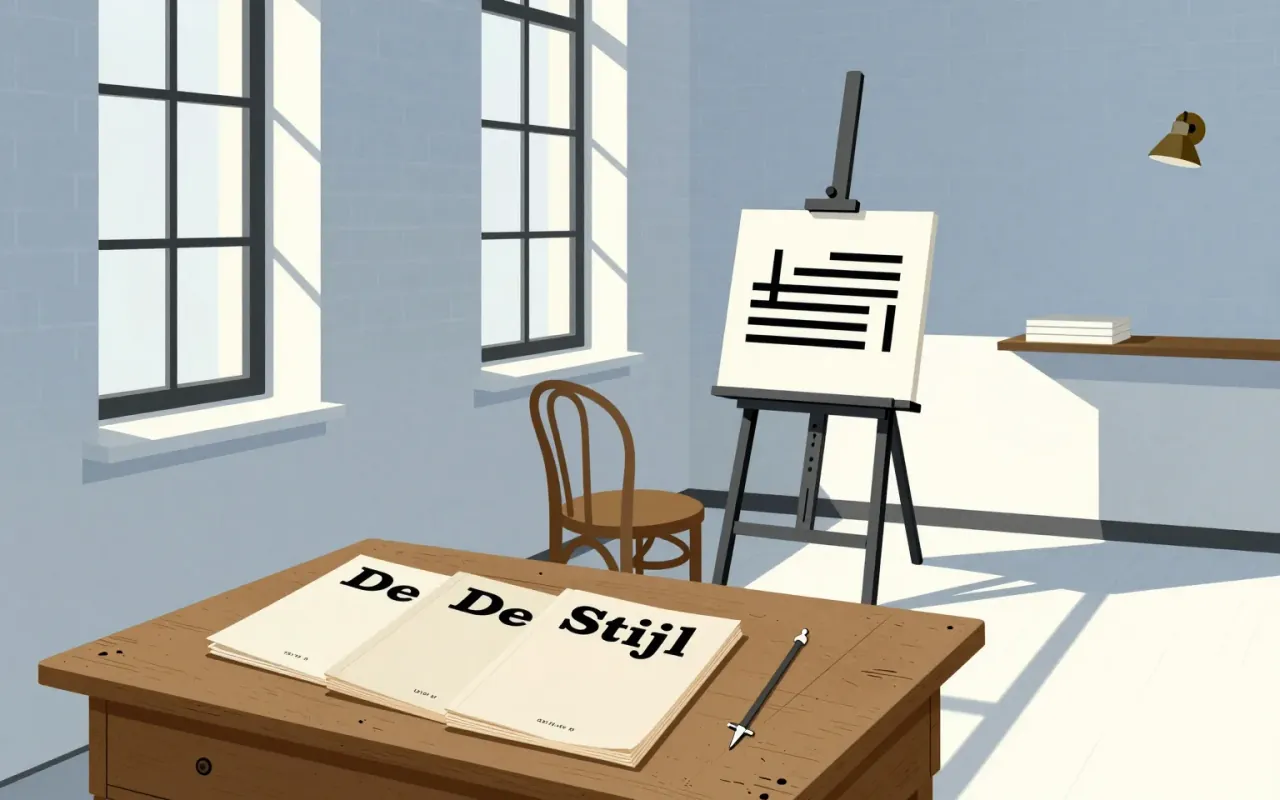
De Stijl is a journal and an art movement founded in 1917. It is not a single object, building, or painting. It is a platform for a theory — Nieuwe Beelding — that prescribed abstraction via elimination: natural form, colour, diagonals, curves, asymmetry, and imbalance were all excluded until they were not.
How it was made
De Stijl was made as a journal edited and published by Theo van Doesburg in 1917. It propagated a formal theory — first called Nieuwe Beelding, later Neoplasticism — articulated by Piet Mondrian in his 1917 essay and 1920 book. The method imposed strict constraints: only primary colours and non-colours; only straight horizontal or vertical lines; only squares and rectangles.
What works
Its constraint-based logic works. Limiting colour to primaries and non-colours, line to horizontal and vertical, and shape to rectangles created a testable grammar. That grammar could be applied across media — from canvas to façade — without dilution. Its clarity enabled imitation, critique, and evolution.
What does not
It does not sustain internal unity beyond 1924. The adoption of diagonal lines and dynamic imbalance under Elementarism contradicts Mondrian’s original neoplastic principles. The movement’s coherence dissolves when its foundational constraints are abandoned.
What it influenced
It influenced architecture (e.g., Rietveld Schröder House), painting, and design through its application of strict formal rules across disciplines. Its journal format made theory portable and reproducible — a publishing decision that amplified reach beyond the studio.
Is it worth your time
Yes. It is worth your time because it codified abstraction as a system of exclusion — not just what to include, but what to remove. Its rigour makes its later fractures (e.g., the 1924 shift to Elementarism) legible as deliberate breaks, not drift.