What the work is
Fabio Novembre is an Italian architect and designer whose output includes retail stores, hotels, restaurants, furniture, lighting, sanitary ware, and large-scale art installations.
Wikipedia gives his birth as 21 October 1966. He moved to Milan in 1984 and took a degree in architecture there in 1992. In 1993 he lived in New York City, where he attended a filmmaking course at New York University. In the same year as his first commission, 1994, he opened his own studio in Milan.
How it was made
Novembre’s work was made through commissions spanning architecture, industrial design and art installations, beginning with the 1994 Anna Molinari Blumarine shop in London.
The shop was followed by further Blumarine stores in Singapore, Hong Kong and Taipei in 1995. Later retail and hospitality interiors include the Café l’Atlantique bar-restaurant in Milan (1995), the Li Cuncheddi hotel in Olbia (2000), the Tardini store in New York (2000) and the UNA Hotel Vittoria in Florence (2003). From 2006 came Stuart Weitzman stores, starting in Rome and reaching Beijing, Beverly Hills, Hong Kong, New York and Paris by 2008.
From 2001 he worked for Italian design brands including Cappellini, Driade, Meritalia, Flaminia and Casamania. The furniture list includes the ORG table and NET carpet for Cappellini (2001), the S.O.S. Sofa Of Solitude for Cappellini (2003), the Nemo chair and Luciola lamp for Driade (2010) and the OK stool for Kartell (2011). He also designed a Void System sanitary ware line for Flaminia (2008) and Happy Pills and Murana vases for Venini (2012).
What works
His work establishes a model for designer-as-orchestrator: collaborating with municipalities (Milan), car manufacturers (Fiat), and brands (Bisazza, A.C. Milan) to deliver spatial and object-based interventions with clear civic or commercial intent.
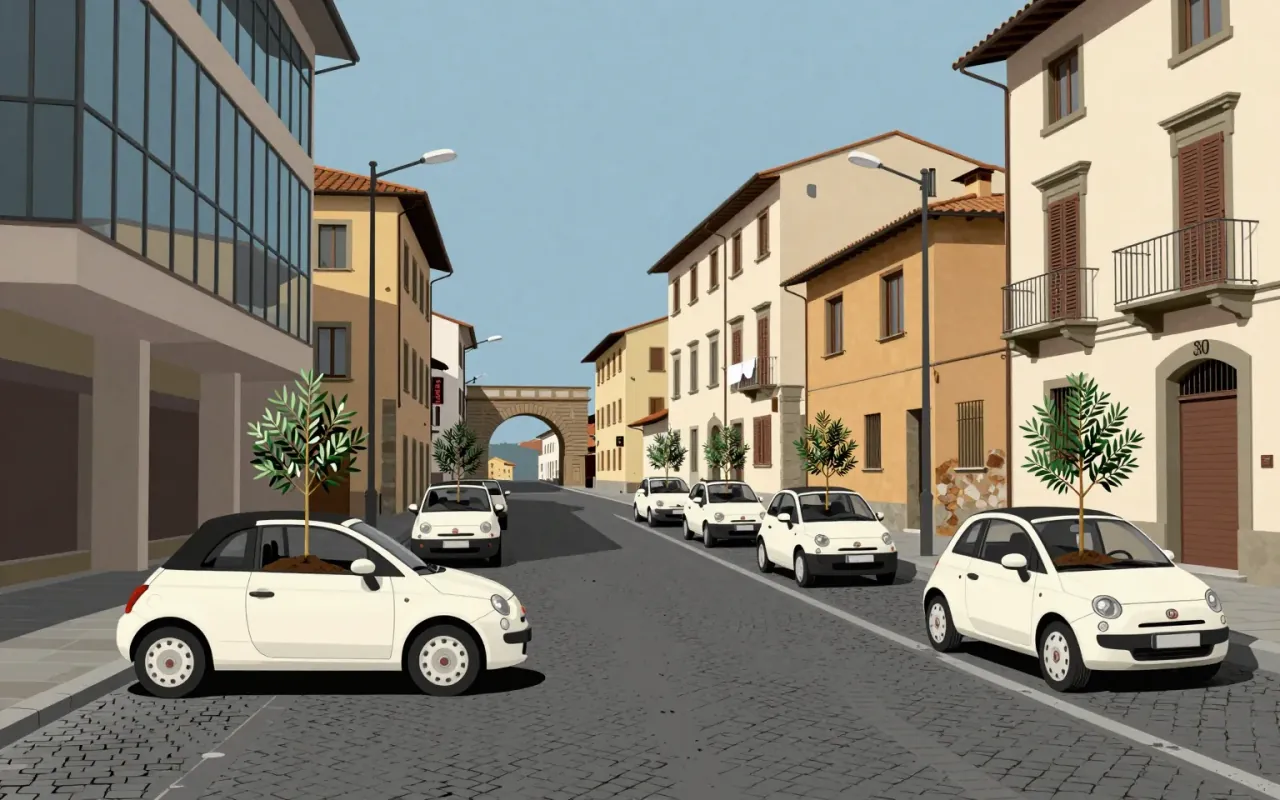
The Per fare un albero installation of 2009, made with the city of Milan’s Department of Design, Events and Fashion and Fiat, placed 20 full-size fiberglass planter replicas of the Fiat 500C cabriolet along Via Monte Napoleone, the city’s fashion centre. It stayed up for several months. His exhibition record lists the installation for Milan, Paris, Madrid and Capri, 2009/2010.
In 2008 the Municipality of Milan hosted an exhibition of his work, “Teach me the freedom of swallows”, at the Rotonda di Via Besana. In 2009 the Triennale Design Museum of Milan invited him to curate and design “Il fiore di Novembre”, and in 2010 he designed and curated an installation representing the City of Milan in the Italian Pavilion at Expo Shanghai. In 2011 he art-directed the Lavazza exhibition marking the 20th anniversary of its calendar and designed the Steve McCurry exhibition at MACRO Testaccio in Rome. In 2014 Casa Milan, the new headquarters of A.C. Milan, opened with all interiors designed by him.
What does not
The material does not establish any consistent formal language, technical innovation, or critical framework binding his architecture, furniture and installations.
What it influenced
His role as Art Director at Bisazza (2000–2003) contributed to the international growth of the mosaic tile brand — but no influence beyond that is verified.
His Bisazza work includes stands in Stuttgart and Bologna (2000) and showrooms in Barcelona (2001), Milan (2002), New York and Berlin (2003). He took part in lectures and workshops from Delft (2001) to Havana (2003), the Royal Institute of British Architects in London (2004) and the Vitra workshop at Boisbuchet (2008), and published A Sud di Memphis in 1995 and Il design spiegato a mia madre in 2011.
Is it worth your time
Yes — his practice demonstrates how a designer can operate across scales and sectors without collapsing into stylistic repetition or brand servitude.