What the work is
A curatorial and convening practice focused on live, social-ecological design initiatives—primarily through the Netherlands Design Institute and Doors of Perception.
How it was made
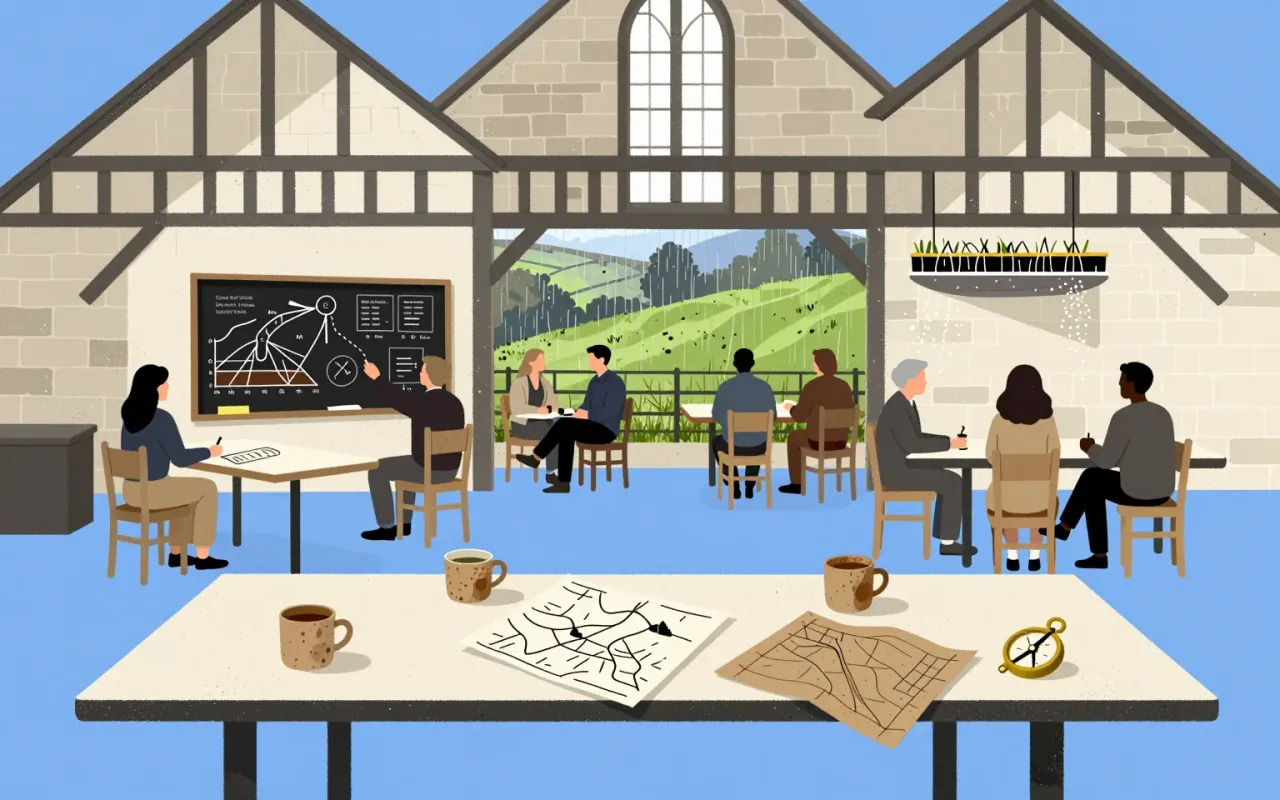
Thackara convened interdisciplinary, place-based projects that brought together design specialists, users, and experts from many disciplines. He framed these through two guiding questions: ‘what is new technology for?’ and ‘how do we want to live?’.
The Netherlands Design Institute was founded in 1993 by the Dutch government and the city of Amsterdam as a think-and-do tank whose mission was to increase the economic and social contribution of design. Thackara was its first director, from 1993 to 1999, assisted by deputy director Gert Staal. He left in 1999 and set up Doors of Perception as an independent company in 2000.
As an independent event company, Doors of Perception organised festivals in Europe and India that brought grassroots innovators together with designers to imagine sustainable futures and take practical steps to meet basic needs in new ways. Its results are published on the Doors of Perception website and discussed at the conference. Thackara curated the conference from 2000 to 2016.
What works
It established a repeatable format: identify real-world sustainability experiments, gather diverse stakeholders, publish results online, and discuss them publicly at conferences. This made sustainability tangible, situated, and participatory.
What does not
The material does not establish Thackara’s authorship of specific artefacts, his disciplinary training, or any physical output such as products, buildings, interfaces or publications he designed.
What it influenced
The Doors of Perception conference became the flagship output of the Netherlands Design Institute, shaping how sustainability was discussed in design discourse through live examples and hybrid community engagement.
His other curatorial and convening work, includes programme director of Designs of the Time (Dott), the social innovation biennial in England, and curator of City Eco Lab, the French design biennial in Saint-Etienne in 2008. With Andrea Paoletti he cofounded the Village Hosts movement in Europe, and he has curated place-based workshops called xskools in 11 countries.
Before the institute he founded and ran Design Analysis International Limited, a small London company whose activities included exhibitions and conferences. Among them were T-Zone, an exhibition of Japanese architecture and video (Brussels and London, 1992), and Sovereign, a national exhibition at the Victoria and Albert Museum designed by Pentagram. T-Zone was named UK Design of the Year by Design Week in 1995. From 1998 to 2002 he was also director of research at the Royal College of Art, where he helped establish the Helen Hamlyn Centre for Design.
He studied philosophy at the University of Kent and journalism at the University of Wales, then worked as a commissioning editor in book publishing from 1974 to 1980. He edited the UK Design Council’s monthly Design from 1980 to 1985, and from 1985 to 1990 he was a freelance journalist, including as design correspondent for The Guardian. He has published online at thackara.com since 1993, and his books include In the Bubble: Designing in a Complex World (MIT Press, 2005) and How to Thrive in the Next Economy (Thames & Hudson, 2015). The Doors of Perception website won a People’s Voice Webby Award in 1999.
Is it worth your time
Yes—if you need a working model of how design practice can pivot from objects to systemic, real-world sustainability experiments.