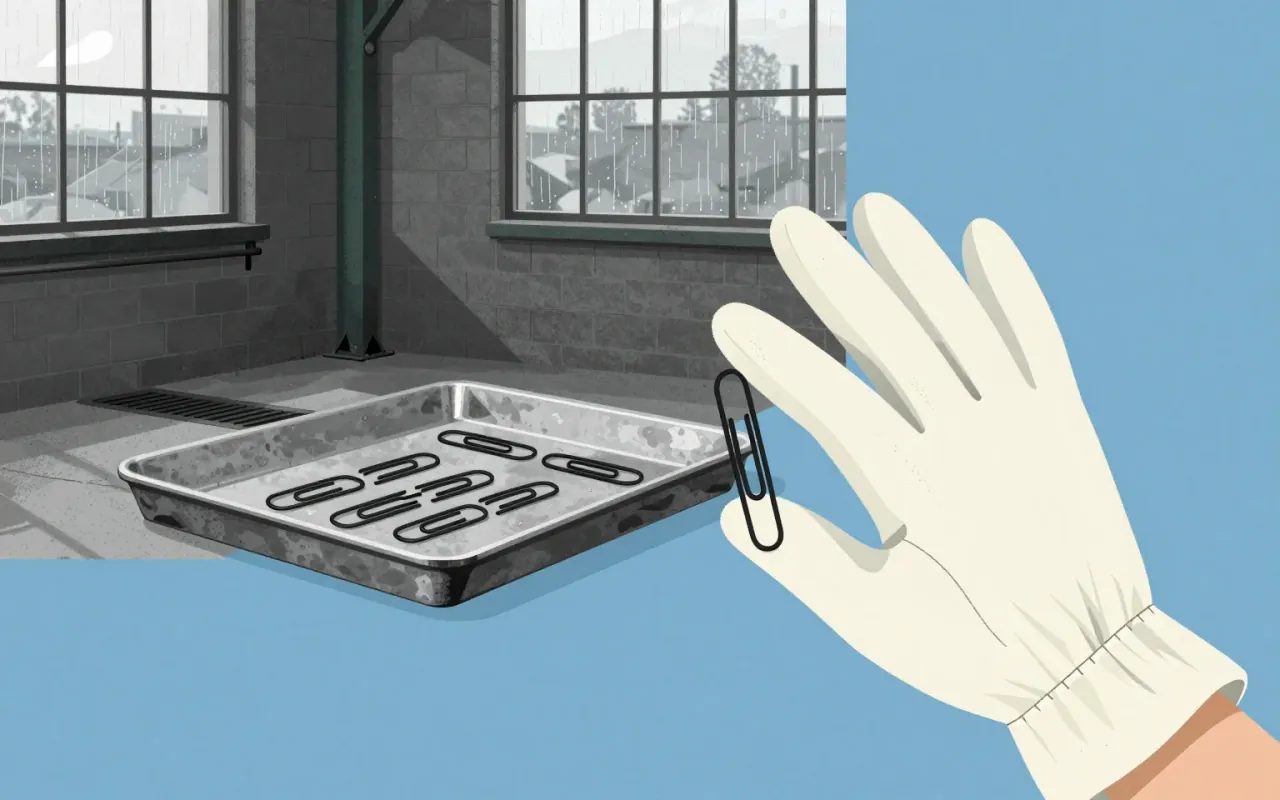
A failed adhesive became a communication tool because 3M let people waste time—and then gave away free samples in Boise.
The Post-it note is a small sheet of paper with a low-tack, reusable, pressure-sensitive adhesive. It emerged from a failed adhesive experiment (1968), five years of internal neglect, a hymn-book insight (1974), bootleg development, and opportunistic colour selection. Its communicative function was proven through employee message exchange—not market testing. The 1977 'Press 'n Peel' test failed; the 1978 Boise Blitz succeeded only after renaming and free-sample distribution. It is worth attention because it reveals how industrial innovation depends less on intention than on permission, accident, and low-fidelity validation.
A small sheet of paper with a low-tack, reusable, pressure-sensitive adhesive on its back.
How it was made
Spencer Silver attempted a super-strong adhesive in 1968 and accidentally made a low-tack, reusable, pressure-sensitive one. He promoted it internally for five years with no use case. In 1974, Arthur Fry conceived its application as a bookmark in a hymn book. Fry used 3M’s permitted bootlegging policy to develop it. The canary yellow colour came from scrap paper available next door.
What works
It sticks and re-sticks without residue. It communicates by physical placement and visible text. Employee message exchange during prototyping proved its utility as a lightweight, synchronous, spatial medium.
What does not
It does not solve complex information architecture. It does not scale vertically or structurally. It does not retain data. It does not replace formal documentation.
What it influenced
It influenced office communication norms, sticky-note-based collaboration systems, and the commercial logic of giving away free samples to seed adoption.
Is it worth your time
Yes. It demonstrates how constraints—failed ambition, internal permission, accidental material properties, and low-fidelity prototyping—can produce a durable communication tool.