What the work is
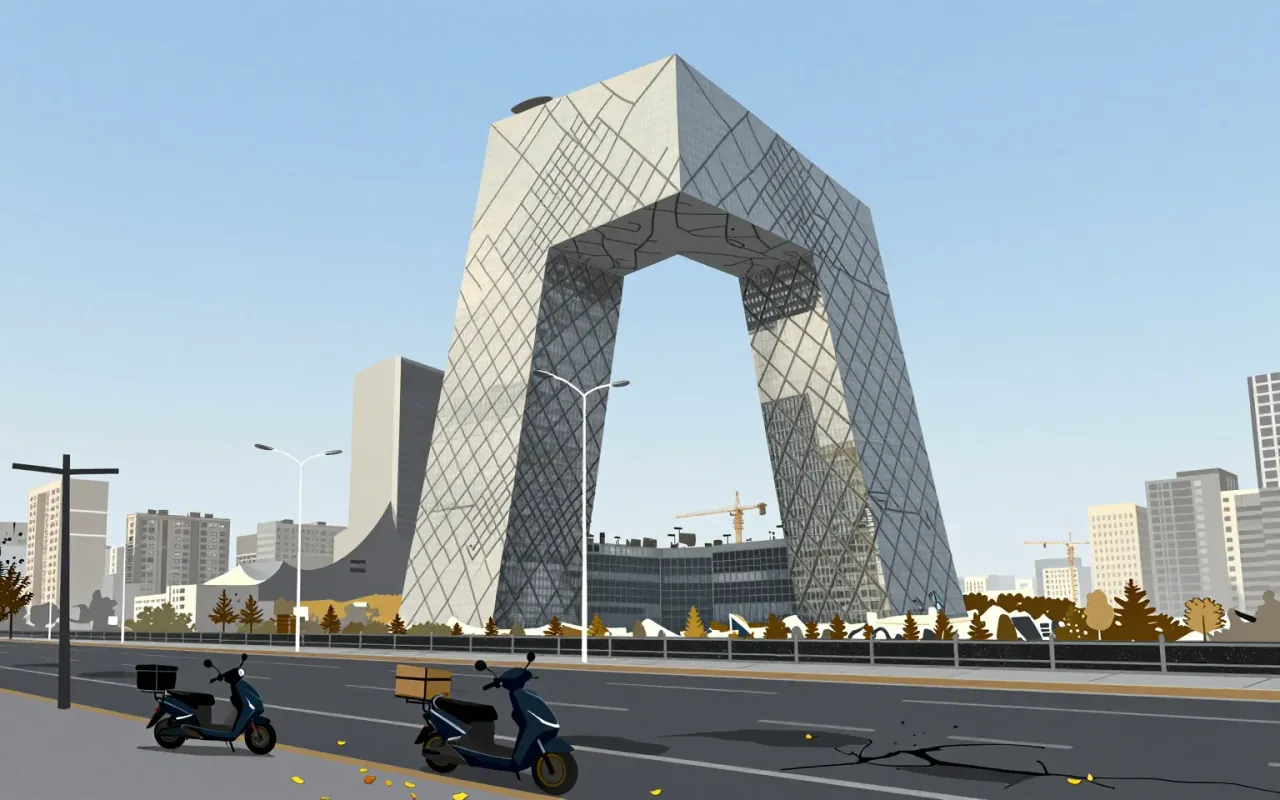
Rem Koolhaas is not a single object but a body of work: theory (Delirious New York), practice (OMA, founded 1975), and built projects (e.g., CCTV Headquarters, 2009). It treats architecture as a tool to edit human activity—not just shelter or symbol.
How it was made
Koolhaas founded OMA in 1975 as a collaborative practice to gain public and critical attention. He interrogated architectural program—editing function and human activity—as a design premise, first in Delirious New York. He developed cross-programming: inserting unexpected functions into room programmes. For the 1980 Venice Biennale, OMA designed a non-historical, non-motif-based façade. For CCTV Headquarters (2009), he patented a ‘horizontal skyscraper’ form in the US.
What works
The CCTV Headquarters integrates departments across a nebulous site and introduces public circulation routes through the building—realising cross-programming as physical access. OMA’s 1980 Venice Biennale façade established a non-historical, non-motif-based alternative to postmodern classicism.
What does not
The CCTV Headquarters circulation scheme provided no effective fire egress for upper floors. This failure was exposed by the 2009 construction fire that nearly destroyed the building and a nearby hotel.
What it influenced
Koolhaas’s interrogation of program and urban form—especially through Delirious New York and OMA’s early projects—set a pace for architectural discourse on cities as additive, addictive machines and collections of ‘red hot spots’.
Is it worth your time
Yes—if you are examining how architectural theory translates into built form, and where that translation fails under real-world stress. The work forces confrontation between conceptual ambition and life-safety consequence.