What the work is
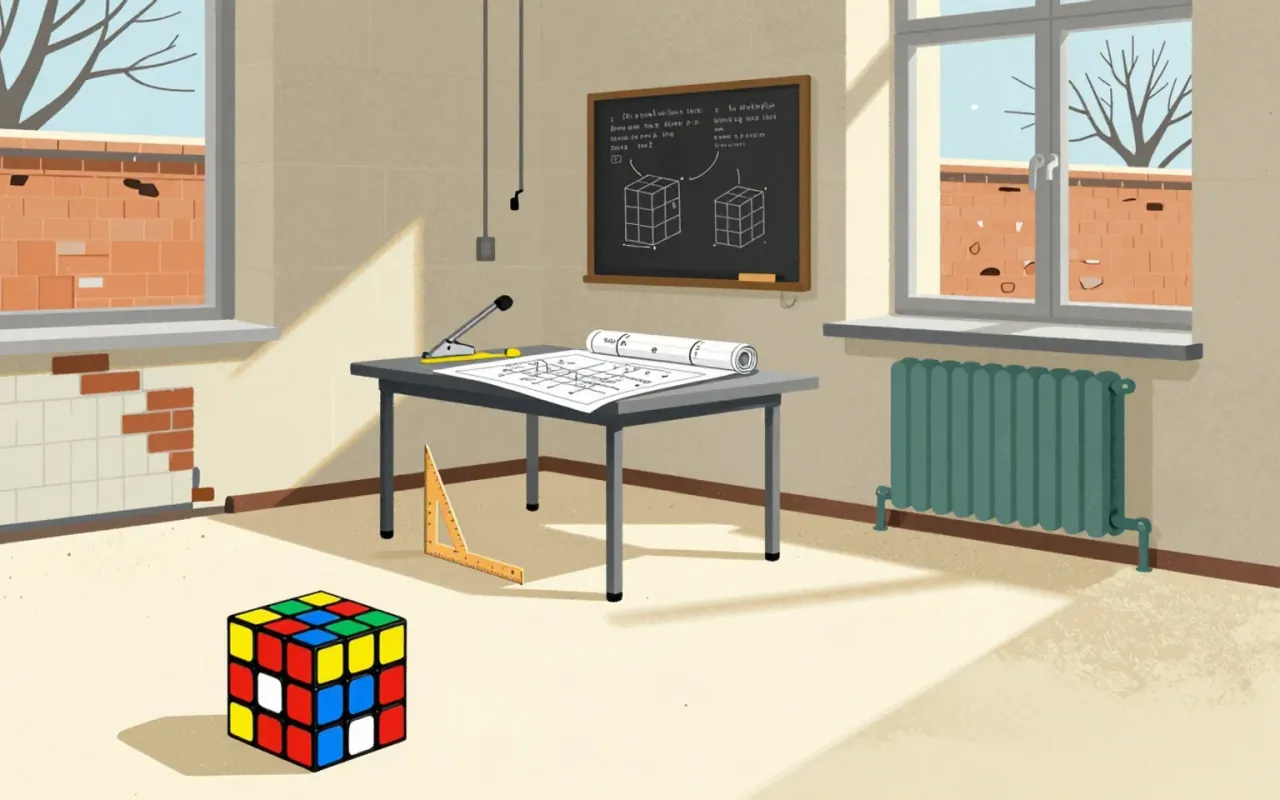
A three-dimensional mechanical puzzle composed of interlocking plastic elements rotating around a central axis. It was invented to solve a structural engineering problem: enabling independent layer rotation while preserving mechanical coherence.
How it was made
Rubik built the first prototype by hand from 27 wooden blocks, cutting them, boring holes, and securing them with elastic bands. He chose wood for its availability in a university workshop and simplicity of manual fabrication. Later iterations used interlocking plastic elements rotating around a central axis, prioritising durability and smooth rotation over earlier magnet-based attempts.
What works
The interlocking plastic mechanism delivers durability and smooth rotation under repeated handling. The combinatorial space forces engagement without instruction. Its physical stability allows scrambling and restoration — a property absent in magnet-based predecessors.
What does not
It does not function as a teaching aid by design. Its utility in illustrating spatial relationships or group theory emerged only after invention and use. Rubik did not build it to teach, nor did he anticipate its recreational or pedagogical uptake.
What it influenced
It influenced industrial design thinking about interlocking kinematic systems, mass-play durability, and puzzle-as-mechanism. It established a template for physical objects whose complexity emerges from simple rules and constrained motion — not from electronics or software.
Is it worth your time
Yes. It is a rare case where engineering constraint directly generated a cultural object — not through intention, but through the act of solving and failing to solve it. Its mechanical logic remains legible, teachable, and physically immediate.