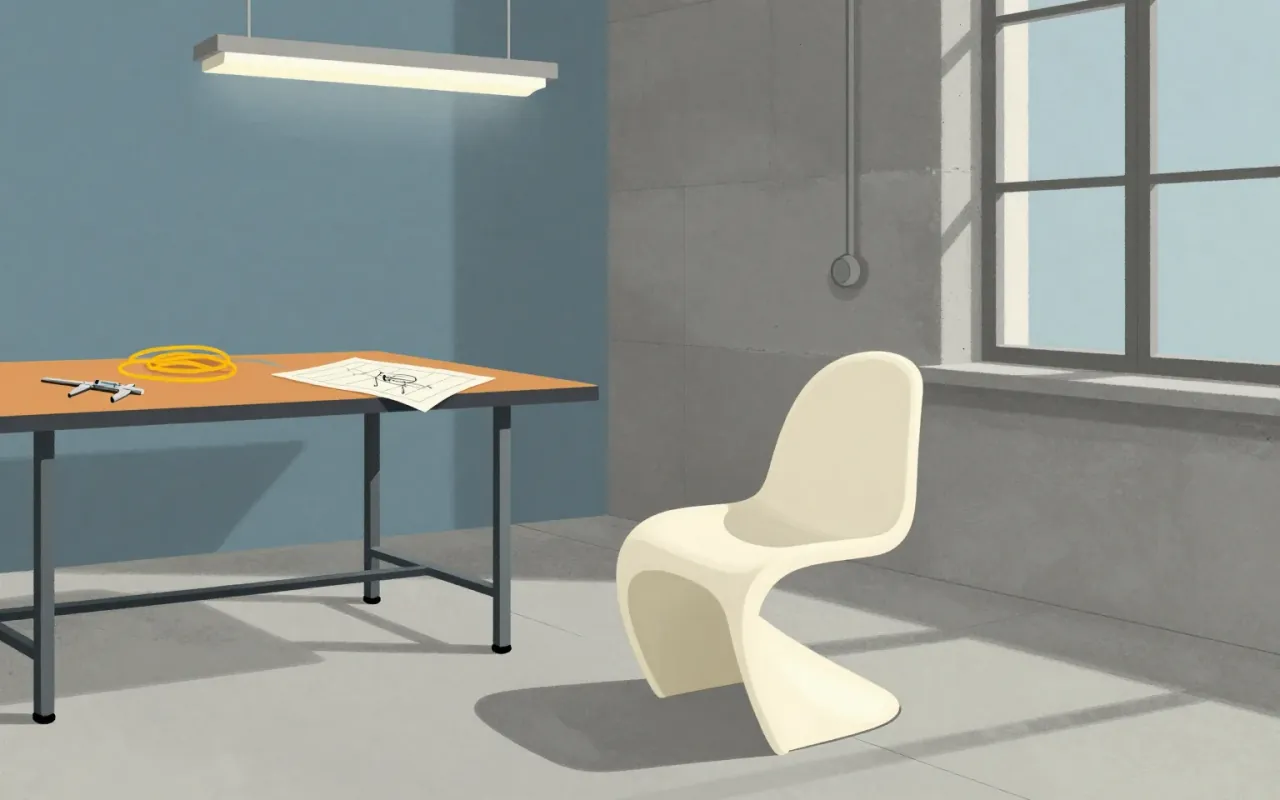
What the work is
An S-shaped, single-piece plastic chair designed by Verner Panton in the 1960s. It has no legs, no joints, no separate back or seat — just one continuous cantilevered form.
How it was made
Panton developed plaster-cast and cold-pressed prototypes — the latter using polyester reinforced with fibreglass — before industrial production used thermoplastic polystyrene and later Baydur polyurethane foam. It was made via single-form injection moulding, a first for chairs.
What works
Its stackability, visual lightness, and sculptural continuity work. The S-curve supports seated posture while enabling nesting. Its monolithic construction eliminated assembly, finishing, and repair points — a direct response to industrial logic.
What does not
The chair does not support heavy or prolonged use in early polystyrene versions; its thin shell and lack of structural reinforcement limit durability. It does not accommodate all body types comfortably — its fixed S-curve prioritises form over adjustability.
What it influenced
It influenced industrial design’s embrace of monolithic plastic forms, proving single-piece injection moulding could scale. It set precedent for ergonomic abstraction in seating — not by mimicking anatomy, but by echoing its curves as pure shape.
Is it worth your time
Yes. It redefined what mass-produced furniture could be: a continuous organic form in plastic, not an assembly of parts. Its constraints — stackability, cantilever, leglessness — forced radical simplification.