10:24in productionCh. 1 · Two Pieces, One Chair/ 10:24 · ceiling 15 min
Furniture
Grete Jalk
Grete Jalk didn’t invent bent plywood — she proved it could carry Denmark’s reputation on two curved slabs.
Grete Jalk’s work delivers high-impact form through disciplined material economy. Her 1963 GJ Chair and 1974 cardboard exhibition system show how constraint — not novelty — became her signature. She advanced Denmark’s global reputation for modern furniture design without inventing new processes or entering mass production. Her chairs won prizes but stayed prototypes. Her cardboard solved real logistical problems. This is design as calibrated reduction.
A body of furniture and exhibition design from the 1960s–70s, including the 1963 GJ Chair and the 1963 He/She Chairs, plus a 1974 travelling exhibition system using corrugated cardboard.
How it was made
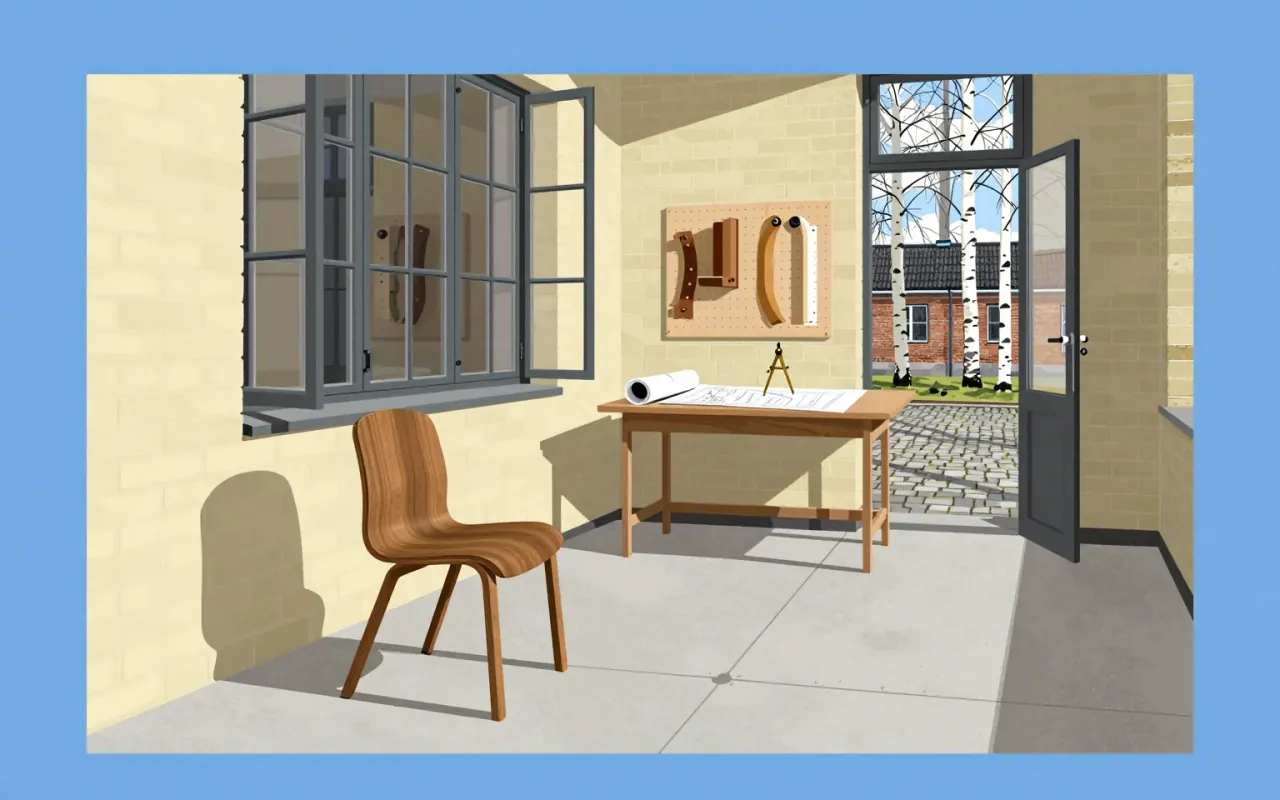
Jalk bent plywood into complex curves, inspired by Aalto and Eames. She used two plywood pieces for the 1963 GJ Chair. For a 1974 travelling exhibition, she built cube-shaped corrugated-cardboard boxes that doubled as stands, wall displays, showcases, and light fixtures.
What works
The GJ Chair’s two-piece bent-plywood construction achieves bold form with minimal material. The cardboard exhibition system is multi-functional, lightweight, and reproducible — directly serving mobility and cost constraints.
What does not
The He and She Chairs never entered full production. Jalk’s work does not establish new manufacturing processes or redefine ergonomics — it optimises existing ones for efficiency and recognisability.
What it influenced
Her materially economical designs contributed to Denmark’s enhanced global reputation for modern furniture design from the 1960s onward.
Is it worth your time
Yes — if you are studying how material economy and structural simplicity shaped Danish modernism’s global reception in the 1960s–70s.