What the work is
TeamLab is an art collective producing digital artworks where gallery space behaviour depends on viewers to function and create cohesive interactive moments.
TeamLab is an international collective of artists, programmers, engineers, CG animators, mathematicians and architects who call themselves “ultra-technologists”. It was founded in 1998 by Toshiyuki Inoko and Shunsuke Aoki while studying engineering at the University of Tokyo, with three friends. The group was officially incorporated in March 2001, when Inoko graduated. It made little profit at first and grew through websites, smartphone applications, and office and store designs for corporations. In 2011 Takashi Murakami invited it to the Singapore Biennale, and a second invitation to his Taipei gallery later that year was its first big break in the art world. Pace Gallery has represented it since 2014.
How it was made
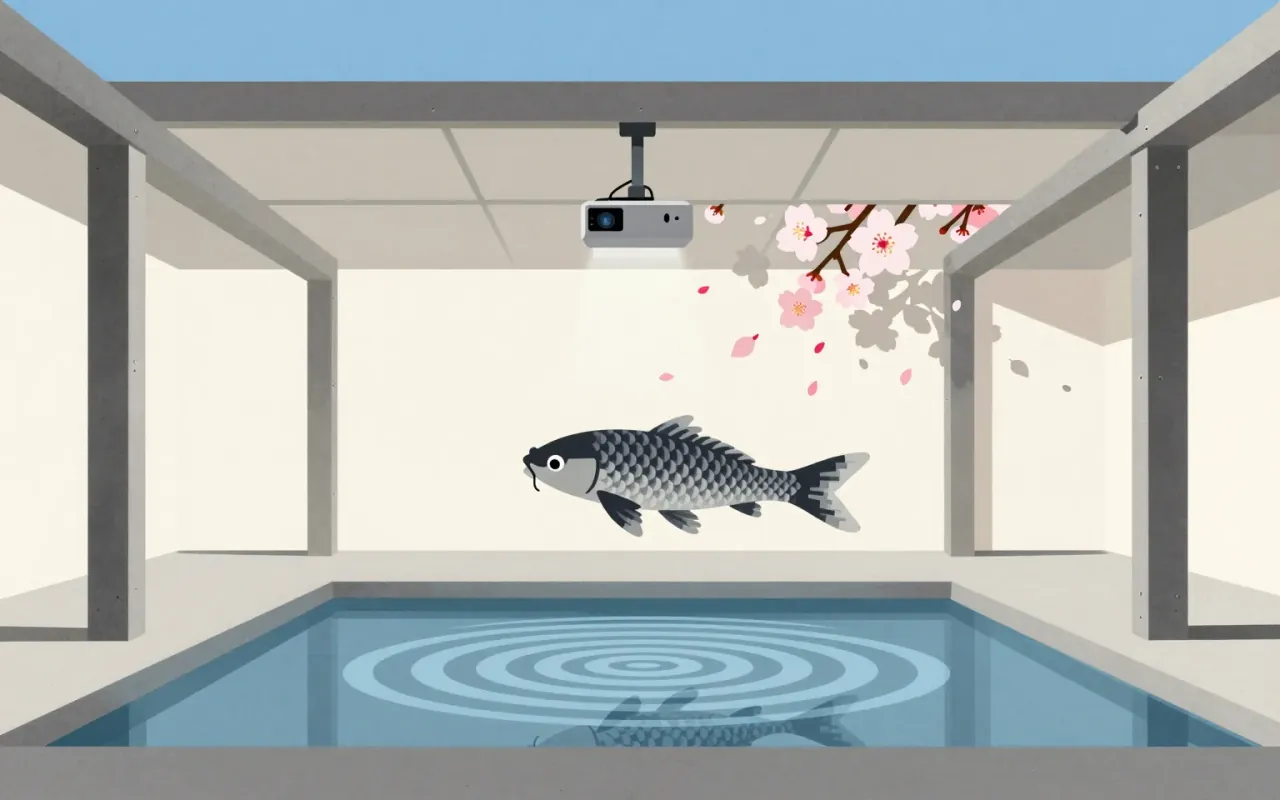
TeamLab exhibitions use EPSON digital technology. This includes touch-reactive areas, projected images, and pre-coded/animated reactions.
What works
The work immerses the recipient’s body in an interactive world and intends to show the relationship between nature and artificial creations.
In Continuity, shown at the Asian Art Museum of San Francisco in 2021 and 2022, visitors can kill a butterfly, grow a field of flowers or startle a fish so that it darts to another part of the room. TeamLab Borderless opened in Tokyo on 21 June 2018, jointly operated with Mori Building; its artworks can interact with each other, so birds from one room can fly into another and change to match that room’s style. At teamLab Planets in Tokyo, opened on 7 July 2018, visitors go barefoot so that they can immerse their whole bodies in the artworks, and in some the viewer enters water. In late 2020 the collective opened Resonating Life in the Acorn Forest at the Kadokawa Culture Museum, where ovoid shapes in the woods respond to touch and wind.
What does not
The material does not establish that the work resolves technical limitations of projection mapping, achieves real-time generative behaviour, or operates without pre-coded logic.
What it influenced
The material does not state what TeamLab influenced. No claims about influence appear in the sources.
Is it worth your time
Yes—if you are researching early 2000s digital art collectives that treat interactivity as a structural condition, not a feature.