4:21in productionCh. 1 · Who runs Tokyo?/ 4:21 · ceiling 15 min
Urbanism
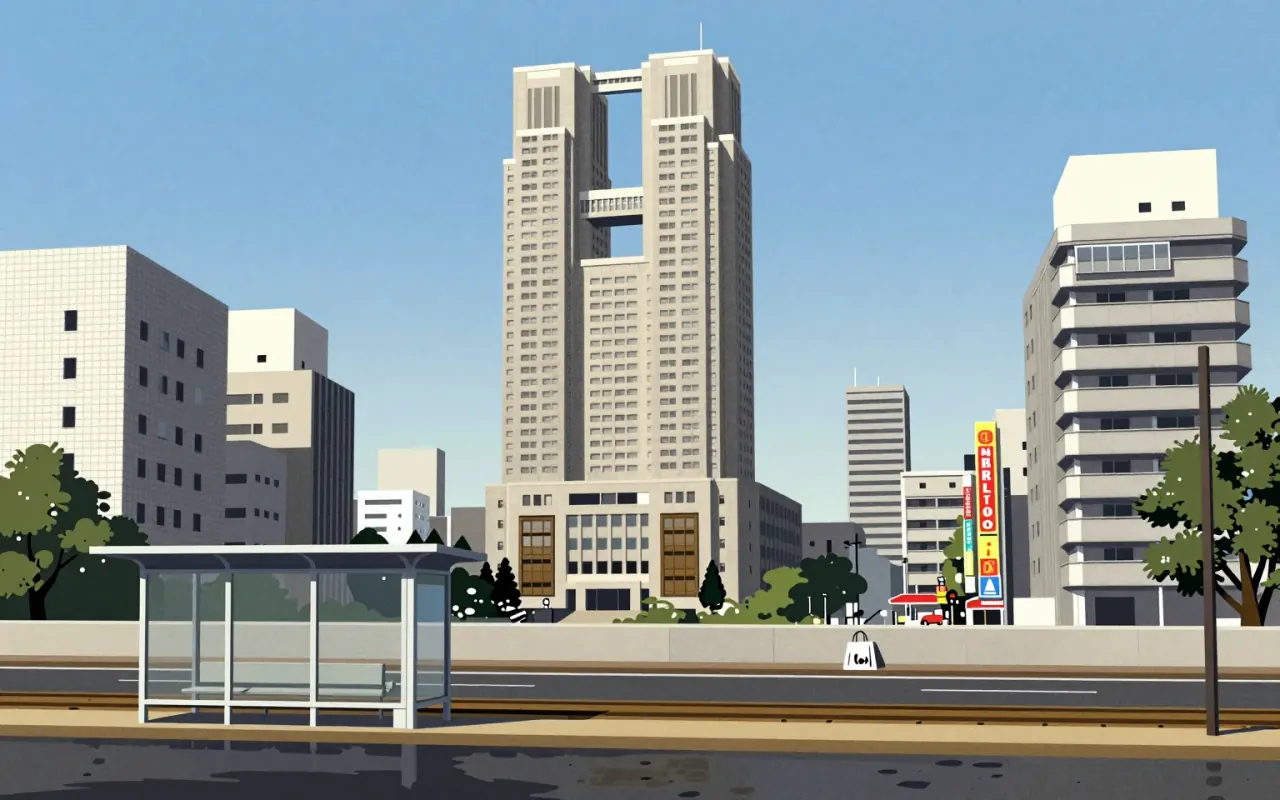
Tokyo Metropolitan Government Building
1991
A cathedral of silicon: this city hall declares power through contradiction, not coherence.
The Tokyo Metropolitan Government Building is a declarative civic object: tall, symbolic, and formally assertive. Its design resolves no functional contradiction — instead, it amplifies them. It trades legibility of governance for legibility of form. It is worth your time because it shows how architectural symbolism can operate without semantic discipline.
its scale asserts institutional presence unambiguously
the tripartite layout clarifies functional separation
the bifurcation delivers usable observation space without sacrificing vertical identity
What does not
resolve symbolic tension between integrated circuit and Gothic cathedral
integrate public realm beyond observation decks
establish new models for legislative transparency or citizen access
Study it if
architects studying late-modern civic typology
urbanists assessing symbolic infrastructure
students of Japanese post-bubble public investment
Skip it if
those seeking participatory design precedents
researchers of adaptive reuse or sustainability
practitioners looking for modular or replicable systems
The design analysis1 min read
What the work is
A 1990 administrative complex housing the Tokyo Metropolitan Government. It comprises three structures: a 48-story No.1 tower, a 37-story No.2 building, and an eight-story Assembly Building.
How it was made
Kenzo Tange designed a three-structure administrative complex in Shinjuku. Each structure occupies a city block. No.1 tower is 48 stories tall and bifurcates at the 33rd floor. The complex includes three underground levels.
What works
The bifurcation at the 33rd floor creates a distinct silhouette and enables observation decks with panoramic views. The tripartite layout separates executive, legislative, and administrative functions across physically discrete buildings.
What does not
The building does not resolve tension between its two stated references: integrated circuit and Gothic cathedral. One reads as technological literalism; the other as historical pastiche. Neither fully informs function or circulation.
What it influenced
It established a template for late-20th-century municipal architecture that prioritises vertical spectacle over horizontal civic integration. It did not influence urban policy, public access models, or legislative transparency.
Is it worth your time
Yes — it redefines civic scale through explicit symbolic duality, not abstraction. Its ambition is legible in massing, not just rhetoric.