What the work is
The Jewish Museum commissioned Anni Albers in 1965 to make a Holocaust memorial. The resulting Six Prayers, dated 1965–66 in its collection, comprises six vertical tapestries.
The collection record gives its dimensions as 73 1/4 by 117 inches (186.1 by 297.2 cm) and its credit line as a gift of the Albert A. List Family. It lists the work as not on view. The record gives Albers’s dates as 1889, Berlin, to 1994, Orange, Connecticut.
How it was made
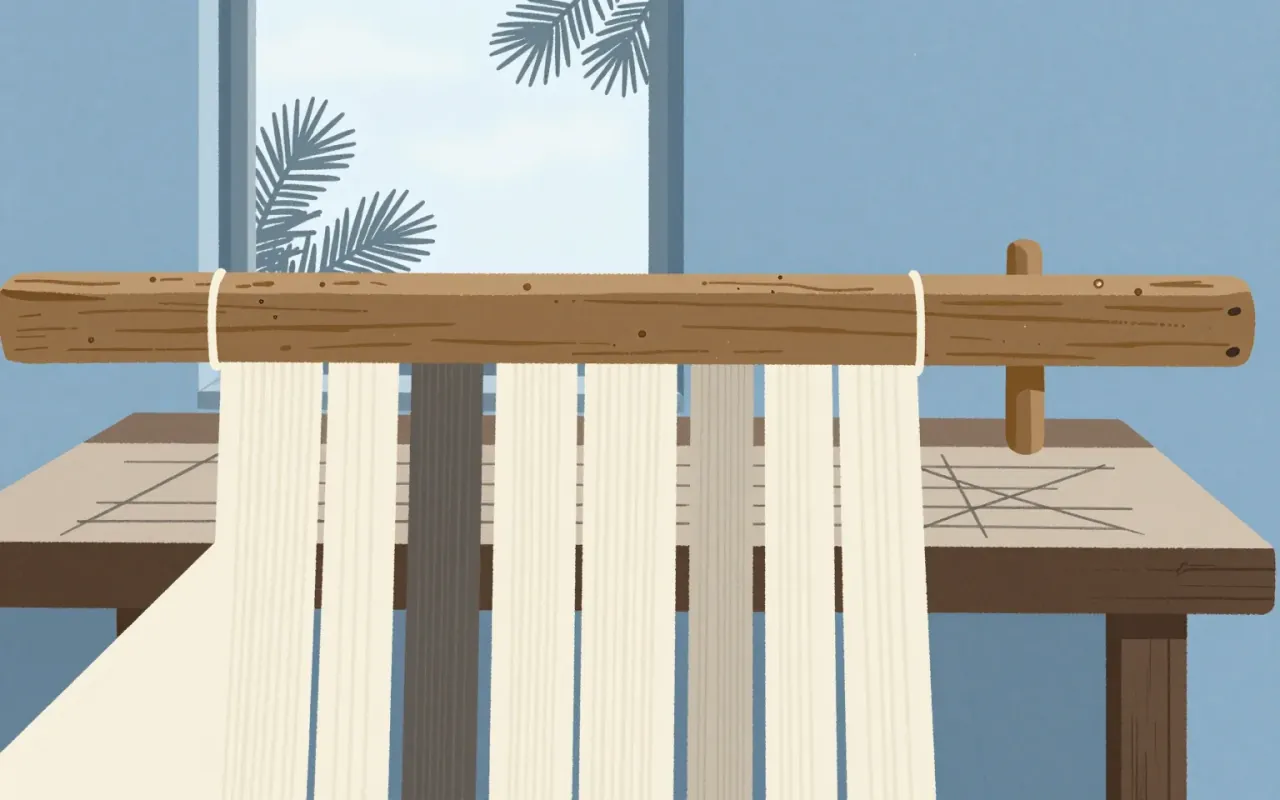
Albers used cotton, linen, bast and silver thread. The museum describes a restrained palette and irregular threads crossing the woven grid, so structure and visual expression arise together rather than through a picture applied afterward.
In the museum’s account, the six tapestries are woven in beige, black, white and silver. Albers varies the weave so that one of those colours dominates each panel, which gives every segment its own tone. Against the grid of warp and weft she sets meandering threads of black and white; the museum reads their irregularity as suggesting an individual will, or many wills, charting a personal path across an imposed order. It also reads weaving, the intertwining of separate threads, as a symbol of tikkun, or social repair.
What works
The difference between the repeated panel format and individual passages rewards slow attention. It allows the work to be considered as a whole while preserving variation within it, an important tension in a memorial to lost lives.
The museum describes the threads as something like texts spreading across scroll-like tapestries, with words both evoked and denied as the threads appear and disappear. It calls the six panels solemn in their monumentality and yet intimate.
What does not
Formal analysis alone cannot explain the commission’s historical meaning. Detached from its memorial context, a textile detail can be mistaken for an exercise in pattern; the context must remain part of its presentation.
The museum’s own essay raises Wilhelm Worringer’s Abstraction and Empathy; it notes that Albers much admired Worringer in her Bauhaus days, and says she may have meant to evoke something of its sense of anxiety and loss. It offers this as a possibility rather than a fact, and adds that Albers believed nonobjective art could reach beyond what representational art can communicate.
What it influenced
The museum places the work within Albers’s pictorial weaving practice. It demonstrates textile’s capacity for public remembrance, without requiring a claim that weaving or abstraction had only one historical direction.
The museum’s text says Albers was born into an assimilated Jewish family in Berlin, studied weaving, and emigrated to America with her husband, Josef, a painter who taught at the Bauhaus. At the Bauhaus she learned from Paul Klee the expressive freedoms of the formal grid, and in the fabrics of ancient Andean cultures she recognised a powerful visual language. The museum says she developed her own “pictorial weavings,” mounted on linen bases and framed, and credits her with raising textiles from utilitarian product to a medium of aesthetic statement.
Is it worth your time
Worth sustained viewing with the commission in mind. Move between the six-part arrangement and the individual threads. The work asks for attention to both material decisions and the people its memorial purpose recalls.