Across several kinds of space
Frederick Kiesler was an Austrian-American architect, theatre designer, artist and theorist. His work included stage designs in Europe, the Film Guild Cinema in New York and the Shrine of the Book in Jerusalem, designed with Armand Phillip Bartos. In 1922 he created a multimedia stage design with a kinetic design of moving side screens and a 2.5 metre iris. It was the first production to marry media projection and flowing water. In 1924 he organized the Internationale Ausstellung neuer Theatertechnik and arranged the world premiere of Ballet mécanique.
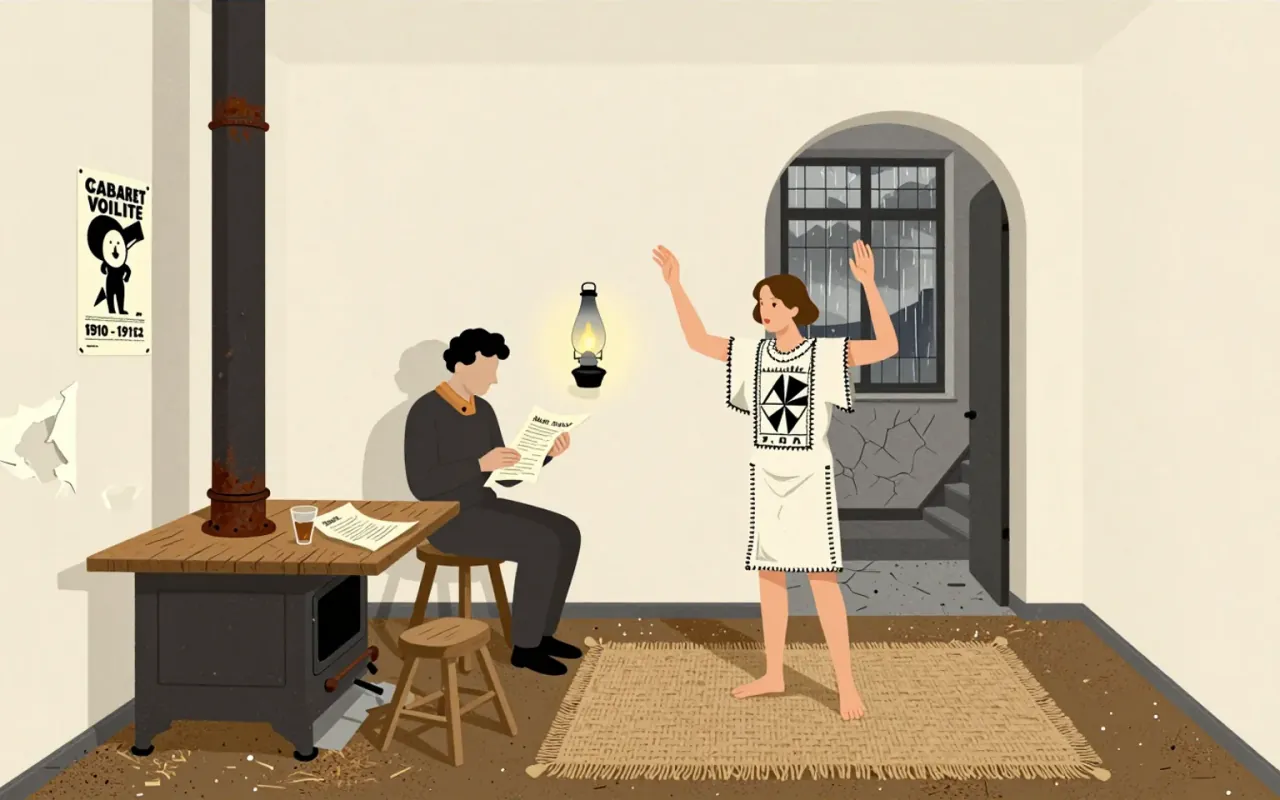
Wikipedia gives his dates as 22 September 1890 to 27 December 1965, and says he was born in Czernowitz, now Chernivtsi, Ukraine. He studied at the Technische Hochschule in Vienna in 1908–09 and attended painting and printmaking classes at the Akademie der bildenden Künste from 1910 to 1912, leaving in 1913 without a diploma. In 1920 he began a brief collaboration with Adolf Loos, and in 1923 he became a member of the De Stijl group. He moved to New York in 1926, where he worked early on with the Surrealists and with Marcel Duchamp.
The 1922 stage design was for the Berlin production of Karel Čapek’s Rossum’s Universal Robots, with film sequences projected onto a waterfall. The Ballet mécanique premiere took place on 24 September 1924, a 16-minute film directed by Dudley Murphy and Fernand Léger, with Man Ray. In 1924 he also invented the L+T (Leger und Trager) hanging system for galleries and museums.
Projects and proposals
Kiesler directed Columbia University’s Laboratory for Design Correlation from 1937 to 1943. His work for Peggy Guggenheim’s Art of This Century gallery included biomorphic furniture. He designed that furniture to dissolve visual, real, image, and environment into a free-flowing space. The Endless House remained a proposal, presented in model form at the Museum of Modern Art in 1958–59.
The Endless House stemmed from his 1920s shop-window displays and from the Film Guild Cinema (1929). He was a window designer for Saks Fifth Avenue from 1928 to 1930. His writing included the 1930 book Contemporary Art Applied to the Store and Its Display and the 1949 article “Pseudo-Functionalism in Modern Architecture”. At Columbia, the study programme was more pragmatic and commercially oriented than his theoretical ideas such as “correalism” or “continuity”, which concern the relationship among space, people, objects and concepts. The Art of This Century furniture dates from 1942, in the Abstract Gallery room.
He also designed furniture, and a few pieces were featured in the yearbook of the American Union of Decorative Artists and Craftsmen, which he helped found in 1930. None of it was reproduced in numbers as he intended, though some models have been made in limited quantities by European firms since 1990. The most popular has been the cast-aluminium Two-Part Nesting Table of 1935.
In the 1950s he painted a series called Galaxies, multi-panelled works that protruded from the wall and were shown as grouped units, with the space between the parts treated as important as the paintings. His later sculpture included Us, You, Me (completed 1963–65) and Bucephalus, conceived in concrete and mesh between 1962 and 1965 and cast in aluminium after his death, between 2006 and 2008.
A comparison to make
Compare an exhibition interior with the Endless House model. Ask how each organizes relationships between a person, an object and surrounding space. Keep the difference between a built environment and a proposal visible: they provide different kinds of evidence about use. Kiesler is especially rewarding to study across these formats, where a recurring spatial question can be examined without collapsing distinct projects into one style.
Wikipedia also records that he was often shunned by his peers, although the Museum of Modern Art chose him in 1952 as one of “the 15 leading artists at mid-century”. Israeli architects disapproved of his and Bartos’s appointment for the Shrine of the Book because they were not Israelis, and objected that he had not completed his architecture studies and had built no structures, despite being a licensed architect in New York State since 1930. A Columbia colleague joked that he would test metal alloys for six months to produce an expensive device that held two pieces of wood together almost as well as a screw.
Since his death the Austrian Frederick and Lillian Kiesler Private Foundation was set up in 1997 to research his legacy, and the biennial Austrian Frederick Kiesler Prize for Architecture and the Arts carries 55,000 euros. Its recipients, as listed, include Frank O. Gehry (1998), Cedric Price (2002), Toyo Ito (2008) and Junya Ishigami (2024).