What the work is
A 300-metre wrought-iron lattice tower built for the 1889 Exposition Universelle in Paris. Its form is a pylon of four girders diverging at the base and converging at the top, joined by metal trusses. It includes Sauvestre’s decorative arches, glass pavilion and cupola.
How it was made
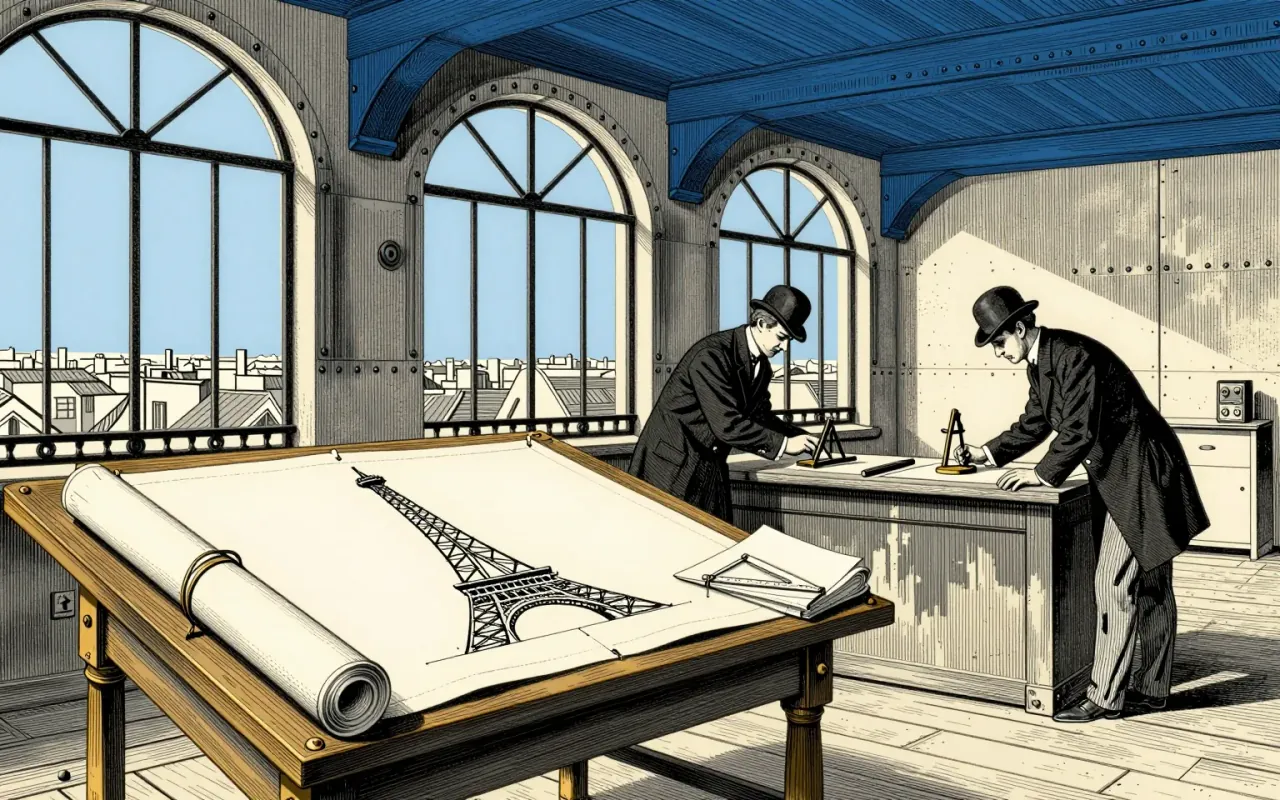
The Eiffel Tower was made from 18,038 distinct iron parts, each specified in 1,700 general and 3,629 detail drawings. Rivet hole positions were defined to 0.1 mm; angles to one second of arc. All fabrication and fitting corrections occurred off-site. No drilling or shaping happened on site.
What works
The lattice structure delivers extreme height with minimal material. Off-site fabrication enabled speed and precision. The rule change ensured execution — not debate — became the project’s central constraint.
What does not
The tower does not stand as Gustave Eiffel’s singular authorship. It does not represent unmediated engineering purity: Sauvestre’s arches, pavilion and cupola were integral to its acceptance. It does not reflect open competition — rival proposals were rejected as impractical or under-detailed after rules were altered to mandate a 300-metre four-sided metal tower.
What it influenced
It influenced the conflation of structural logic with national symbolism, establishing a template for exposition architecture where technical specification serves ceremonial function.
Is it worth your time
Yes — for its ruthless calibration of engineering precision against political theatre, and as a case study in how a design becomes inevitable not by merit alone, but by rule change.