A failed resettlement project that rewrote the rules of low-cost housing by rejecting industrial materials—and proving that failure can be more instructive than success.
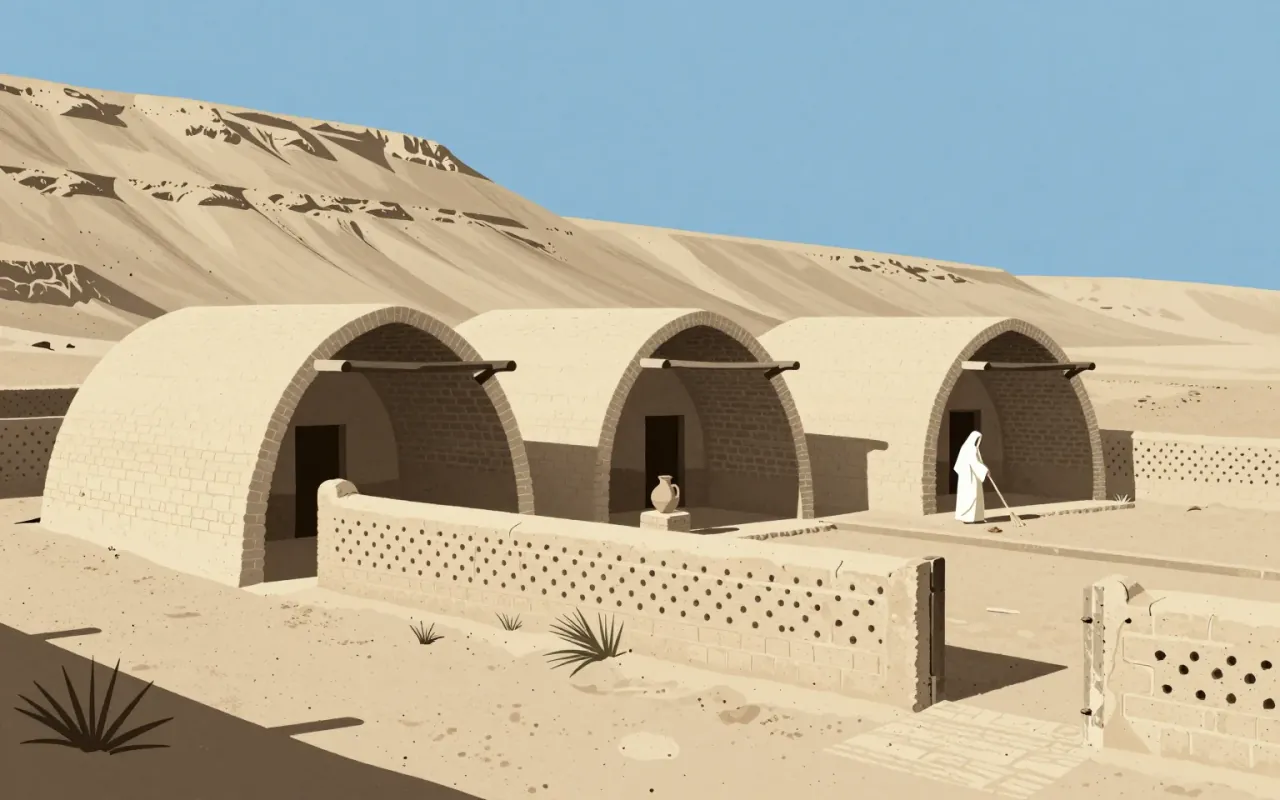
Hassan Fathy’s New Gourna is a resettlement project built with mud brick on Luxor’s West Bank to relocate Gourna village from archaeological zones. Fathy substituted mud brick for steel, cement, timber, and glass because those materials were economically unsuitable. He consulted every family in Gourna and advocated for social ethnographers in planning. He adapted Nubian designs—enclosed courtyards and vaulted roofing—from a 1941 trip, and used Nubian claustra and Gourna vernacular techniques. His plan addressed economic, social, and aesthetic issues in low-cost housing. But Fathy described the Gourna Experiment as a failure in Architecture for the Poor. It influenced later work in passive cooling, windcatchers, and earth architecture.
New Gourna is a resettlement project built with mud brick on Luxor’s West Bank to relocate Gourna village from archaeological zones.
How it was made
Fathy designed New Gourna to resettle Gourna village from within archaeological zones on Luxor’s West Bank. He substituted mud brick for steel, cement, timber, and glass because those materials were economically unsuitable. He consulted every family in Gourna and advocated for social ethnographers in planning. He adapted Nubian designs—enclosed courtyards and vaulted roofing—from a 1941 trip, and used Nubian claustra and Gourna vernacular techniques.
What works
The plan addressed economic, social, and aesthetic issues in low-cost housing through mud brick construction, direct community consultation, and adaptation of Nubian and local vernacular forms.
What does not
New Gourna did not succeed as intended. Fathy described the Gourna Experiment as a failure in Architecture for the Poor.
What it influenced
It influenced later work in passive cooling, windcatchers, and earth architecture.
Is it worth your time
Yes. It is worth your time as a foundational case study in how material constraint, direct consultation, and vernacular adaptation shape low-cost housing—not as a resolved success, but as a declared failure that catalysed decades of earth architecture practice.