What the work is
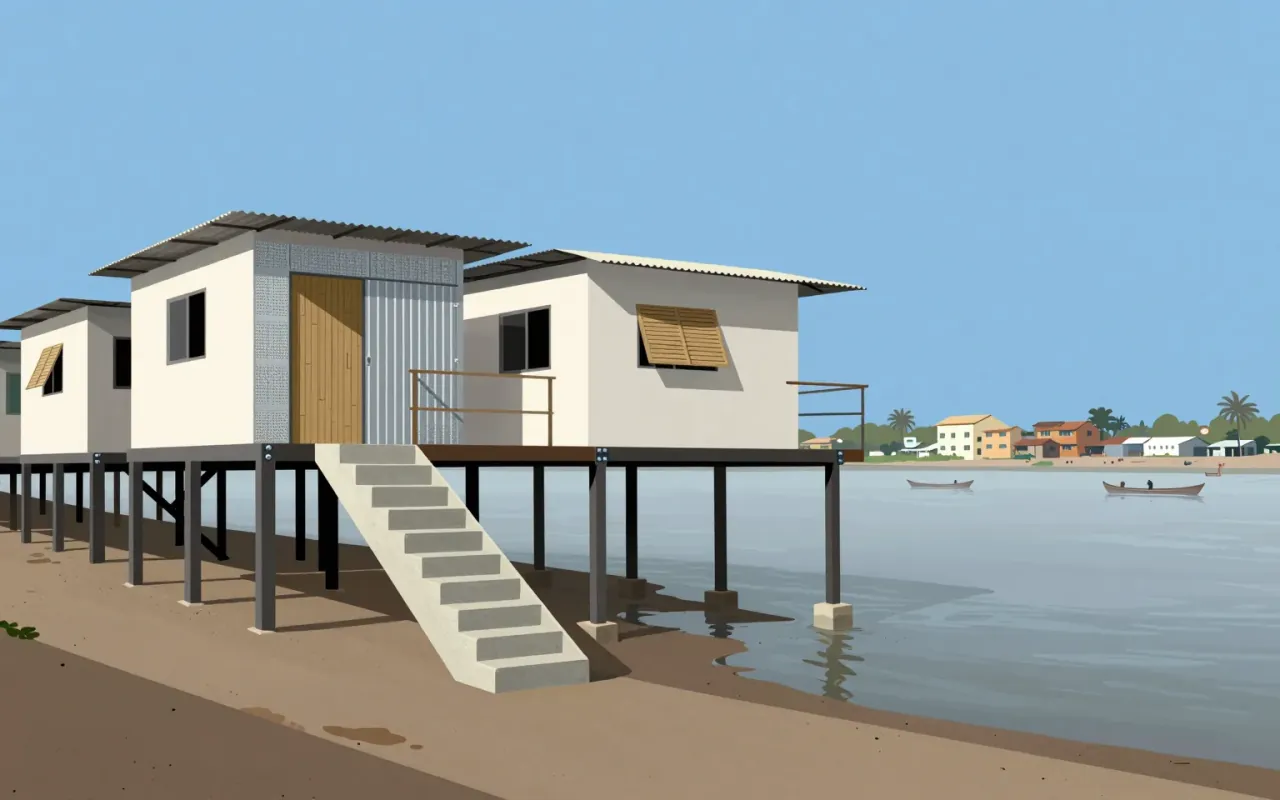
A body of built and unbuilt architecture from 1923–1933—including workers’ clubs, exhibition pavilions, and housing—defined by sawtooth units, raised cubical volumes, single-sloped roofs, and glazed corners.
According to Wikipedia, Melnikov’s first success in architecture was a 1922 workers’ housing entry codenamed Atom, which used the sawtooth arrangement of units that became his trademark, based on traditional single-family townhouse and apartment units rather than a “revolutionary” scheme.
How it was made
Melnikov worked independently between 1923 and 1933, using formal strategies shaped by material constraints and Soviet technological limits—not Constructivist doctrine.
Melnikov kept a clear distance from Constructivism. In 1923 and 1924 he briefly associated himself with the ASNOVA and LEF groups, made no public statements and clearly distanced himself from the Constructivist group led by Moisei Ginzburg and Alexander Vesnin. Glazed corners were shared with the Constructivists; the single-sloped roof was against their canon but matched a Soviet industry that lacked the technology for reliable flat roofing.
Two of his best-known solutions had practical reasoning behind them. The bold exterior stairs on his clubs followed from 1920s building codes that required a wide internal staircase for fire evacuation; connecting the main halls to exterior galleries, which the code did not regulate, saved interior space. His own house in Krivoarbatsky Lane, built in 1927-1929, is two intersecting cylindrical towers of brick honeycomb with 60 of more than 200 cells glazed and the rest filled with clay and scrap. This was a direct consequence of state material rationing, which limited him to scarce brick and wood.
What works
The sawtooth pattern solves functional problems: it enabled car egress without reversing in garages and structured housing layouts with light and access. Raised volumes and glazed corners maximise light and spatial legibility within supply-limited construction.
The clubs show the most variety. Trade unions commissioned 30 clubs in the Moscow region in 1927, ten of them in the city, and Melnikov won five of those ten; his sixth club is in Likino-Dulyovo. All six differ in shape, size and functional set. Because the unions were not competent in the exact functions of the buildings, each draft was also a functional programme, and, according to Melnikov, a club is a flexible system of halls that can be united into one large volume when necessary.
What does not
It does not conform to Constructivist orthodoxy. Single-sloped roofs and sawtooth plans were pragmatic responses to unreliable flat-roof technology and garage circulation needs—not ideological statements.
What it influenced
The brief does not establish influence beyond Melnikov’s own output. No external works, movements, or designers are cited as influenced.
In the 1930s Melnikov refused to conform to Stalinist architecture and withdrew from practice. By 1937 criticism of “formalism” had effectively removed him from practice, and his Rusakov Club and Arbat house appeared in Soviet textbooks as examples of Formalism. He worked as a portraitist and teacher and designed a few minor private jobs. He kept his Arbat house until his death in 1974, and his son Viktor, also a painter, fought to have it preserved as a museum until his own death in 2006.
Is it worth your time
Yes. His work demonstrates how constraint-driven formal invention can produce coherent, repeatable architectural logic without stylistic allegiance.