What the work is
A body of built work — including the Centre for Development Studies in Trivandrum (1971) — defined by passive environmental systems, local material use, on-site adaptation, and Gandhian ethics of resource prudence.
How it was made
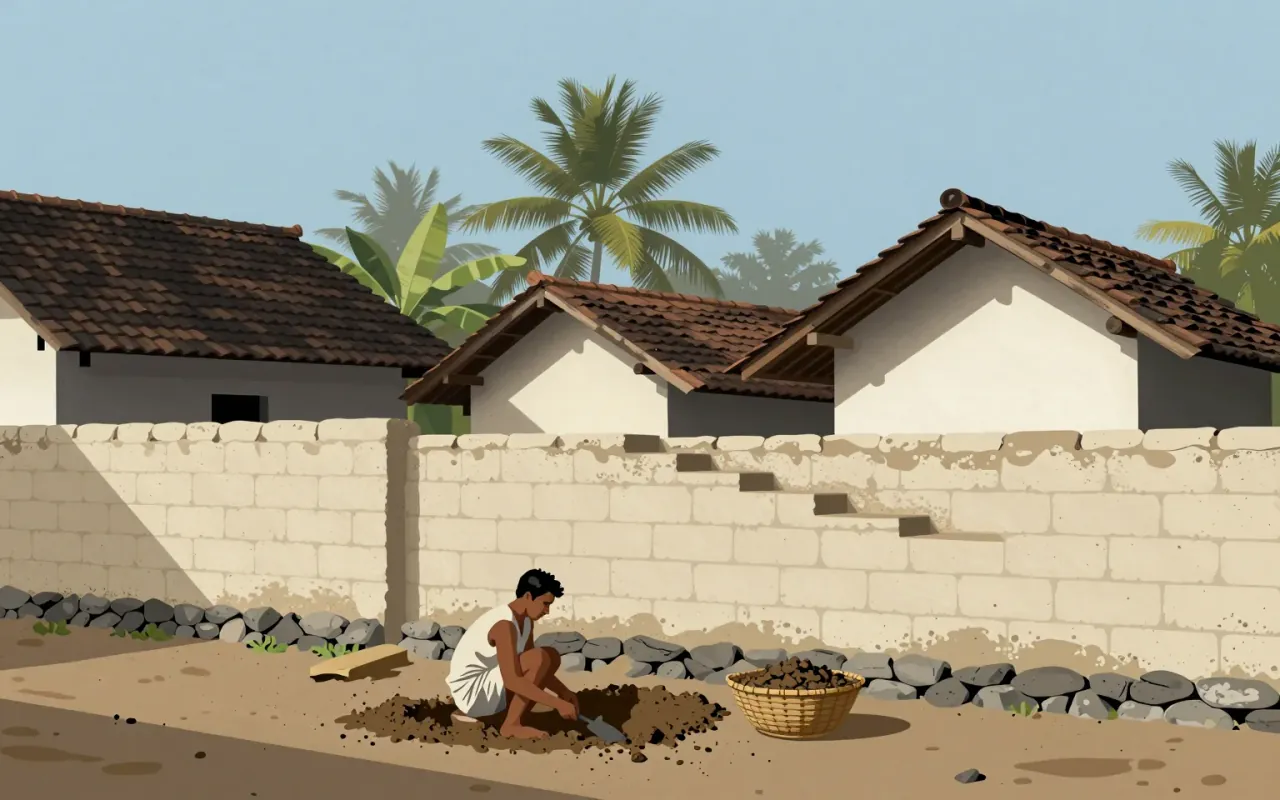
Baker made architecture on-site, not from plans. Most design decisions emerged during construction. He observed vernacular solutions to termites, monsoons, laterite, cow dung and mud walls. His improvisations responded directly to site idiosyncrasies — preserving trees, topography and local material logic.
What works
The latticed brick wall beside a pond at the Centre for Development Studies draws cool air via pressure differences. Using laterite, mud, cow dung and minimal imported materials reduced cost and site damage. Letting topography and trees guide form preserved ecological integrity.
What does not
It does not scale predictably. It does not separate design from labour. It does not rely on standardised components or off-site fabrication. It does not prioritise speed, uniformity or client control over ecological and cultural fidelity.
What it influenced
It influenced low-cost, climate-responsive housing practice across India — particularly in Kerala — and seeded later discourse on vernacular sustainability, though the document does not name specific successors or institutions beyond the Centre for Development Studies.
Is it worth your time
Yes. Baker’s work is a concrete rebuttal to blueprint-first, resource-heavy modernism — but only if you need alternatives rooted in constraint, not aspiration.