What the work is
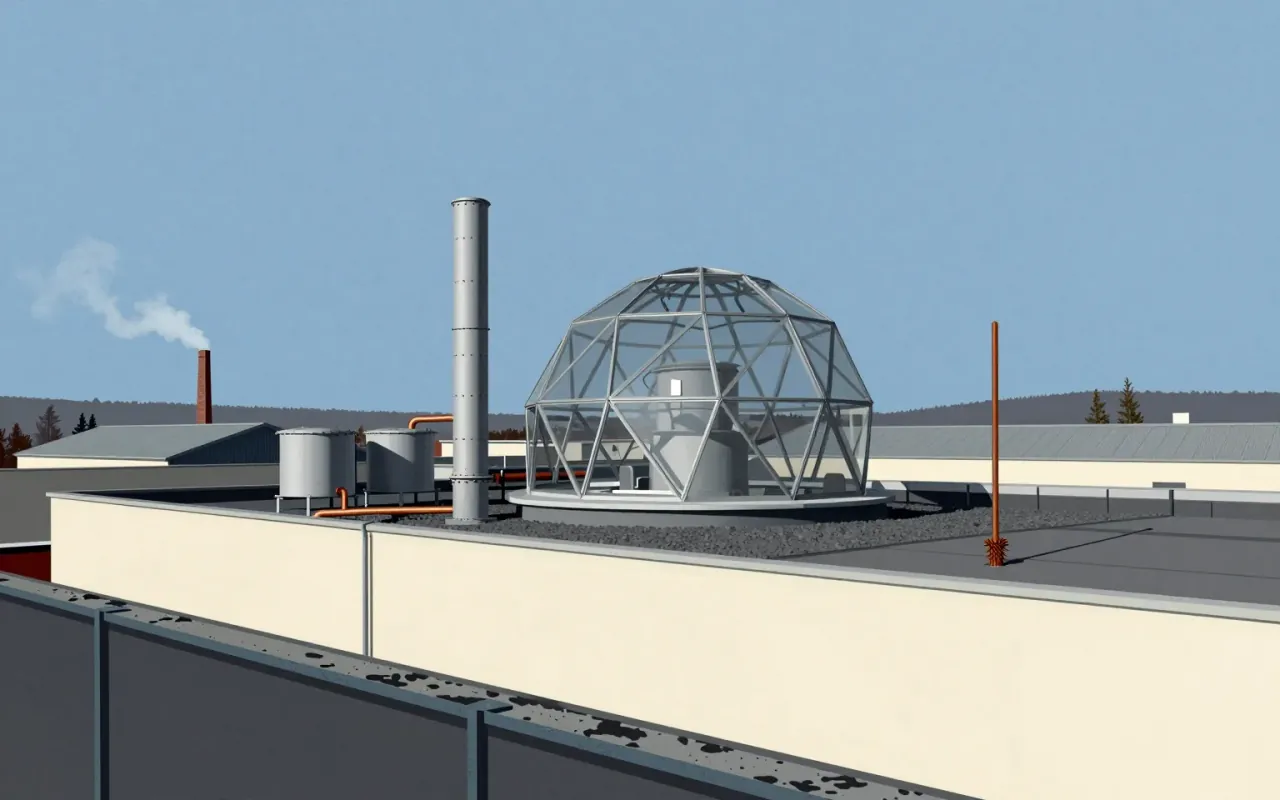
A hemispherical thin-shell lattice structure based on a geodesic polyhedron.
How it was made
Walther Bauersfeld designed the first geodesic dome in the 1920s for a planetarium projector at Carl Zeiss Jena. Dykerhoff and Wydmann patented and built an initial small dome on the roof of Carl Zeiss Werke. Buckminster Fuller coined the term ‘geodesic’ during field experiments with Kenneth Snelson at Black Mountain College in 1948–49. Fuller’s earliest surviving dome was built by students in Woods Hole in 1953.
Bauersfeld was chief engineer of Carl Zeiss Jena, an optical company, and the first dome came after World War I. A larger dome, called “The Wonder of Jena”, opened to the public on 18 July 1926. Fuller is credited with popularising the idea in the United States rather than inventing it, and received U.S. patent 2682235A on 29 June 1954.
What works
Its rigid triangular elements distribute stress across the entire structure, enabling high load-bearing capacity relative to size.
The dome appealed to Fuller because it was extremely strong for its weight, its “omnitriangulated” surface was an inherently stable structure, and a sphere encloses the greatest volume for the least surface area. It was adopted for specialised uses such as auditoriums, weather observatories and storage facilities. In 1975 a dome was built at the South Pole, where resistance to snow and wind loads mattered.
What does not
The dome does not solve enclosure, climate control, or interior usability on its own. It establishes structural efficiency but offers no inherent answer to insulation, acoustics, access, or habitability.
Fuller hoped the dome would help address the postwar housing crisis, but residential domes have been less successful than those used for work and entertainment, largely because of their complexity and greater construction cost. Lloyd Kahn, who wrote Domebook 1 and Domebook 2, became disillusioned and called domes “smart but not wise”. His listed problems include material wasted when rectangular boards are cut into triangles, expensive fire escapes, code-conforming windows costing five to fifteen times as much as in conventional houses, and difficulty with partitioning, expansion and privacy. Sealing the many seams against rain was hard for builders using cut-board sheathing in the 1960s and 1970s.
What it influenced
It influenced lightweight architecture, emergency shelter design, exhibition pavilions, and modular construction systems — all relying on triangulated rigidity over continuous surfaces.
Early uses included 21 Distant Early Warning Line domes built in Canada in 1956, Kaiser Aluminum domes, and from 1954 U.S. Marines experiments with helicopter-deliverable domes. A pavilion at the 1964 New York World’s Fair and a dome in the American Pavilion at Expo 67 in Montreal, now the Biosphère, brought the form to a wider audience. Spaceship Earth at Epcot opened on 1 October 1982, named after one of Fuller’s terms.
Is it worth your time
Yes — it is worth your time as a foundational structural idea whose material economy and load-bearing logic remain legible in its geometry alone.